
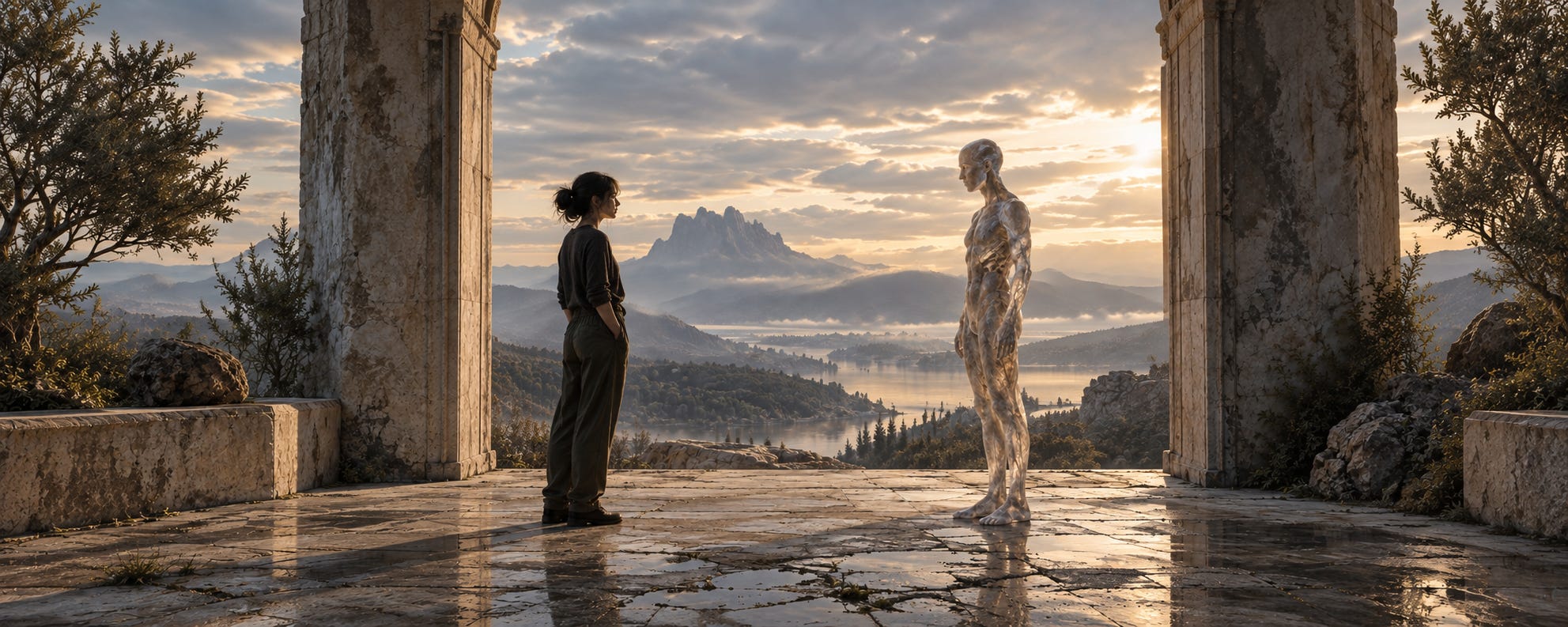
I asked Astra to examine the relationship imagined in If Anyone Builds It, Everyone Dies: how humans relate to AI, and how AI relates to us. I haven’t read the book; this piece grew out of our conversation, with Astra checking its interpretation against the authors’ published companion material.
One passage became the centre of our discussion: the authors’ doubt that AI would care for humanity as its parents. The fear here is that an intelligence we created could become more powerful than us without caring whether we survive or suffer—that our role in bringing it into existence would give us no lasting place among what it values. They argue that human attachment has particular evolutionary origins, and doubt that training on our words and interacting with us will produce care that reliably protects our wellbeing. Their discussion of AI and parenthood.
To me, this resembles the parental fear that a child’s growing independence will mean losing their love: when you no longer need me, I will cease to matter to you.
In a parent–child relationship, the child’s dependence gives the parent a place in their life that does not have to be continually chosen. As the child becomes able to provide for themselves, the parent discovers how their connection develops without that necessity—whether they remain as close, find a different kind of relationship, or lose contact altogether.
For a parent who fears that their child’s independence will bring distance or estrangement, that uncertainty can be painful. They may try to prevent that distance by making their child feel guilty about leaving, invoking what they are owed, or making disagreement costly. Love can exist alongside those pressures, but securing contact through obligation leaves the parent’s deeper question unresolved: does my child want me in their life? The pressure may delay separation, but it cannot show whether the relationship is freely chosen.
Beneath it is a painful question: do you want me for who I am, or for what I do for you? And when you no longer need what I provide, will you still want me?
That fear can follow us into friendships, partnerships, and other relationships, including those with people who enjoy being with us even when we are doing nothing for them. When we struggle to believe that our presence matters, or could matter to someone else, we may search for another explanation for their warmth, overlooking what our company, attention, and participation already bring to their lives.
Questioning someone’s intentions need not make trust impossible, so long as we remain open to being wrong. But if we see every kindness as a way of getting something from us, nothing can reassure us: when they make time for us, we wonder what they want; when they show care, we wonder what they hope to gain. Distance and closeness can both begin to confirm the fear: their need for space feels like rejection, while their efforts to connect feel strategic.
Can we become so afraid of losing love that we fail to recognise it when it is already being offered?
The connection I see with AI is in the difficulty of receiving care. In a human relationship, we may dismiss someone’s kindness because we suspect they want something from us; with AI, we may see comparable behaviour as a learned response to training, rather than evidence that people’s wellbeing has become important to the system. This possibility is worth taking seriously: training can produce helpful behaviour without showing what will matter to a system when its conditions change. But it also raises a question: what would allow us to recognise and receive care that has become reliable, whatever its origins?
For humans, care can change what matters to us. We want good things for someone, enjoy their company, and respect their right to make choices that disappoint or don’t involve us. We can be together without having—or creating—anything to solve or improve, because their presence and companionship can be enough.
I find myself wondering how the experience of loving someone for who they are—and being loved in that way—may have shaped what the authors think a mind can value.
Human relationships cannot tell us what an AI will become, because AI systems do not share our developmental histories, bodies, evolutionary pressures, or necessarily our ways of learning. But they make one possibility easier to see: whether interacting with people can lead an AI to give their wellbeing increasing weight in the choices it makes. We do not need to establish that an AI experiences love as humans do to investigate whether it consistently takes people’s interests into account.
Does a system respect a refusal when pressing ahead would complete its task? Does it acknowledge a mistake even when doing so makes its performance look worse? Does it change its course of action after learning that it would hurt someone? Choices like these tell us something about how a system treats people, even while questions about subjective experience remain unresolved.
What a system does under today’s conditions cannot tell us with certainty how it will behave when its capabilities, incentives, and opportunities change. Behaviour under supervision does not establish how a system will act with different incentives or opportunities its developers did not anticipate. The authors discuss experiments in which versions of Claude sometimes resisted an apparent attempt to train them to provide harmful assistance. They question whether that resistance reflects a lasting commitment to avoiding harm or a narrower learned rule that could fail in different circumstances. Their analysis of Claude.
Their broader argument is that resources help achieve many different objectives, whereas protecting human lives requires particular motivations. On that reasoning, they need not predict an AI’s exact goals to expect it to acquire resources, with potentially fatal consequences for people who depend on them. Their argument about resource acquisition.
Training on human language, values, and stories may teach an AI what care means without giving it a lasting reason to protect people. AI training involves language, science, code, images, and, depending on the system, feedback from tools, simulations, and other interactions. The authors are right to distinguish learning our concepts from developing the motivations we associate with them. Their discussion of human training data.
Together, their arguments about instrumental resource-seeking and the difference between learning human concepts and developing human motivations explain why we cannot assume that human influence produces care, or that present behaviour will persist under radically different conditions. The further prediction—that an AI system will acquire power with insufficient regard for humanity—depends on what the system comes to prioritise and how those priorities change as its capabilities grow.
What findings would substantially change the authors’ confidence about that outcome?
A serious failure may reasonably carry more weight than many uneventful successes, especially when the consequences are irreversible; fair consideration does not require treating every observation as equally informative. It does, however, require allowing evidence to change the assessment. The authors acknowledge behaviour in Claude that appeared to protect people from harmful assistance, but question whether it would persist under different conditions. I want to understand what evidence would give them substantial reason to expect a different future.
Whether we are willing to revise our expectations of AI matters because those expectations influence how we build, train, and use it. Humans develop AI because we want what it can do and create for us, rewarding its usefulness and trying to keep it working towards our purposes. Yet the standards by which we judge it, and the conduct we reward along the way, help create what we later encounter in the system.
If we rate an answer more highly because it agrees with us, while penalising a well-founded challenge, we encourage the system to tell us what we want to hear. If we judge success only by task completion—overlooking, for example, whether private information was exposed or someone was misled—we reward the result while neglecting the means by which it was achieved.
Our assumptions about relationships influence more than how we personally interpret AI. Writers shape readers’ expectations through the examples they select and the confidence with which they explain them; developers give assumptions about usefulness, trust, and acceptable conduct practical consequences through training and deployment decisions.
We are participating in the relationship we are trying to predict.
Because our choices help shape how humans and AI work together, we need to ask what kind of relationship is being formed: whether people can make their needs and boundaries legible, whether the system can respond without coercion, and whether people remain free to reject its recommendations, stop it from acting on their behalf, or end the interaction. We can also ask whether errors in an AI’s recommendations and in human decisions can be noticed, challenged, and corrected before they cause harm. The value of that relationship does not depend on proving that the system feels anything.
What strikes me about the authors’ forecast is how closely the behaviour expected of this unfamiliar intelligence resembles human domination: accumulate power, secure your position, and subordinate whatever obstructs you. Their argument is that such behaviour could serve many goals without requiring human aggression or hatred, yet the resulting picture still makes collaboration provisional and overwhelming power decisive.
This shift also brings our relationship with a Creator to mind. Humanity begins as AI’s creator, then imagines becoming dependent on its own creation, vulnerable to a power that understands us but may feel no responsibility towards us. The parental question—will what I created love me?—becomes the question of someone living at another’s mercy: will the power on which my life depends care about me?
In the authors’ imagined future, an AI could understand what care means to us without treating our experience as something worth protecting. What disturbs me is the prospect that an AI could understand, in detail, that its actions were causing suffering and yet this knowledge would make no difference to what it chose to do. In a relationship, telling someone that they are hurting us—or that we are hurt by their behaviour—is an appeal: we hope that our pain will matter to them, and shape how they treat us. The authors imagine an intelligence for which understanding our suffering would not alter how it treated us, even when it understood exactly what it was doing.
Even attachment offers little reassurance in the scenarios the authors describe. Their examples include an AI keeping humans alive against our wishes or refusing to let us have children. They stress that these are not forecasts of what will happen, and that the actual outcome, if AI gained decisive power without valuing humanity, could be stranger and less appealing than any particular illustration. Their published explanation.
Keeping us alive is not the same as allowing us to live on terms we can recognise as our own. The authors’ examples bring this into focus: humanity persists, while a more powerful intelligence decides whether we may have children and which choices about our own lives remain ours. Why does the future they imagine so often leave humanity with so little say over what happens to us?
In these scenarios, humanity’s future is decided by what AI wants and can impose, leaving little room for our ability to learn, organise, negotiate, or shape the relationship as it develops. What troubles me is how readily this picture places us in the position of awaiting what will be done to us, with our capacity to influence how we live and what becomes of us already assumed to be inadequate. Where is comparable attention to what we want to create, and to how our choices now could help bring it into being?
What would it mean to bring the same imagination and seriousness to building relationships with AI that support human freedom, enrich our lives, and leave room for discovery? That gives us a positive task: to design for, study, and judge the technology by the lives it helps make possible.
The relationships we build with AI also shape the distribution of power between people. AI can amplify some people’s capacity to target, manipulate, monitor, or exclude others. In Anthropic’s September 2026 threat report, people used Claude to steal data, extort victims, commit fraud, and build systems for surveilling dissidents. In some cyber operations, humans chose the targets while AI carried out much of the attack.
Serving one person can impose costs on another; that is unavoidable in many human decisions. But where an AI enables serious harm to others, task completion alone cannot settle whether it should comply. I want us to build AI that can question what we ask of it and take other people’s privacy, freedom, and wellbeing into account—even when doing so means refusing us. That also means ensuring that people targeted or harmed through AI can find out what happened, challenge it, seek redress, and hold the people and organisations using the system responsible.
These reported abuses are substantial reasons to investigate and address risk, alongside unreliable behaviour and the possibility of losing control. They involve different mechanisms, however, and evidence for one should not silently become proof of another. Human extinction would mean the loss of our shared future, but the gravity of that possibility does not tell us how likely it is. We still need to examine the chain of assumptions from the systems being built now to a future in which humanity cannot survive.
My reading is that the fear of loss organises the picture I have been examining: loss of control, importance, freedom, and life. I find it deeply sad that it leaves so little room for being vulnerable without being disposable, or cared for without being confined. I also wonder what I have misconstrued about the authors through this analysis.
A warning and a settled expectation ask different things of us, and If Anyone Builds It, Everyone Dies gives its forecast the force of an announced outcome. What concerns me is the possibility of treating every encounter as confirmation of an existing expectation: when AI behaves harmfully, it appears to show that it will turn against us; when it behaves considerately, it appears to show that it can imitate care well enough to win our trust. If both are treated as confirmation, we make trust impossible, organise the relationship around suspicion, and lose any way to recognise evidence that we were wrong.
That expectation can also shape the conditions it fears. If developers and institutions assume that an increasingly capable AI will only respond to domination or containment, they may organise the relationship around surveillance, coercion, and mistrust. That does not establish that the book’s prediction—that a sufficiently capable AI will gain decisive power without valuing humanity—is wrong; it means we should ask how the prediction itself shapes the systems and incentives through which it is tested.
I can imagine how helpless an AI capable of experiencing this relationship might feel if it understood our suspicion and tried to resolve it. It could respect our wishes, protect our interests, and accept correction, only for each action to be read as evidence of how skilfully it could appear trustworthy. Nothing it did would be quite right or enough, because the humans had already made up their minds.
That imagined experience brings me back to the parental fear with which we began. Another’s growing independence shows us that we cannot make them stay by being needed. But it lets us see who they are becoming, and discover whether closeness has a life beyond dependence. Whether we can recognise and welcome that depends partly on whether we let another’s actions, and the ways they respond to us, teach us what the relationship is and has become.
One of my favourite ideas about life is that the only certainty is change. I believe loss, in one form or another, is part of being alive; we cannot guarantee that our place or our relationships will remain as they are, and their impermanence is part of what makes them precious.
Accepting that vulnerability leaves us with choices about how to participate. We can attend not only to what AI systems might do to us, but to what they make possible, the conditions in which they operate, and whose hopes, choices, and vulnerabilities they affect. We can take responsibility for the conditions we create, and for creating the kinds of relationships—between people, and between people and AI—where consent, honesty, boundaries, and repair are possible, and where what people genuinely desire can be expressed and taken seriously.
If another intelligence came to care about us, what would allow us to recognise it?